
The Objective Correlative
The annals say: when the monks of Clonmacnoise
Were all at prayers inside the oratory
A ship appeared above them in the air.
The anchor dragged along behind so deep
It hooked itself into the altar rails
And then, as the big hull rocked to a standstill,
A crewman shinned and grappled down the rope
And struggled to release it. But in vain.
‘This man can’t bear our life here and will drown,’
The abbot said, ‘unless we help him.’ So
They did, the freed ship sailed, and the man climbed back
Out of the marvellous as he had known it.
Seamus Heaney, Lightenings viii
I’m not sure how, but I know this poem is about imagination. The monks at prayer; the appearing ship in the air; the rooting in the physical and then the letting loose; it all speaks with images both clear and fantastical, rooted and liminal, and even dangerous. What does it mean that the great ship, stuck in the altar rail, will “drown” if not freed? What of the great reversal at the close, when the crewman climbs back “out of the marvellous as he had known it”? The poem presents this mythical tale, which dates back to at least the eighth century, as an interplay between two realms, both mysterious to us—the ground-land with its monks and abbots, and the celestial sea above with its flying ships. Somehow, the two are connected.
Here’s what Heaney had to say:
The story has the ‘there-you-are and where-are-you’ of poetry. A boat in the air, its crewman on the ground, the abbot saying he will drown, the monks assisting him, the man climbing back, the boat sailing on. The narrative rises and sets, the magic casement opens for a moment only and the marvellous occurs in a sequence that sounds entirely like a matter of fact. The crewman is a successful Orpheus, one who goes down and comes back with the prize, which is probably what gives the whole episode its archetypal (imitating an original) appeal.
What Heaney is able to do with this story out of a lost age is the same that Dante can do with his otherworldly pilgrimage, or Eliot with his dense Four Quartets. It is the in-and-out that only comes from this weaving together of image and idea, where each relies on the other, informs the other, and provides a momentary flood of images loaded with meaning beyond words.
This is the power of the image, or what Eliot called “the objective correlative” (though he didn’t coin the term). In Eliot’s case, the objective correlative is “a set of objects, a situation, a chain of events which shall be a formula of that particular emotion; such that when the external facts, which must terminate in sensory experience, are given, the emotion is immediately evoked.”
What I find appealing about this is way of thinking about images is that it avoids the often trite, under-imagined, sideline use of illustration and imagery in preaching (and in whole swaths of what we might call “bald idea” poems shared online). In short, much of the way preachers are taught goes like this: the idea is central, the image secondary.
This makes several interpretive missteps. First, there is no idea without images. In the most basic sense, words are images: letters represent phonemes which combine in the mind and mouth of the reader to communicate some form of meaning. Our modern English letters and words may not be hieroglyphs, but they are no less rooted in representing corresponding realities.
And so, all biblical ideas are conveyed in images. “No ideas but in things!” is not just the maxim of William Carlos Williams, but the nature of reality itself. On the physical level, the words of Scripture are things that convey ideas. The papyrus with scribbled, spaceless Kione is itself something that carries meaning. Or put another way, the words themselves are like clay pots hidden in the desert crammed with rolled up scrolls of meaning.
Further still, the ideas which Scripture gives us are contained in their own imagery. Take any bald idea, such as atonement, and you are forced by the very word itself into imagery of sacrifices, altars, law courts, covenants where God as a smoking fire pot walks through the split pieces of sacrifices to make his oath to Abraham (and remember that the Hebrew phrase was to “cut a covenant”). Jesus refused to speak facts unadorned by imagery, even if he did explain the imagery to his disciples. Bryan Chapell says it well: “the biblical record inspired by the Spirit reinforces the conclusion the people tend to seize images more readily than they do propositions, and if they take hold of enough images, they can grasp apt principles” (Christ-Centered Preaching, 3rd edition, 164).
This gets to perhaps the most important point, imagination is how we translate image into understanding. It should surprise no one that the word “imagination” is close relatives with “image.” Imagination is a noun of action (a nounish verb, or verbish noun?) from the Latin imaginari, “to form an image of, represent.” (One of these days look up Coleridge’s distinction between imagination and fancy/fantasy. To him, fancy was “memory emancipated from the order of time and space”, that is, escapism. Think of your least favorite Star Wars film, or any legion of meaningless video games that provide nothing but a flash in the pan. Imagination, on the other hand, is “the living power and prime agent of all human perception, and as a repetition in the finite mind of the eternal act of creation in the infinite I Am.”) Imagination “bodies forth the forms of things unknown” (Shakespeare), and far from being the faculty of genius, it is the vital path to understanding.
Imagination is that faculty that takes these letters you are reading and carries them, as if on a ship across the sky, into your mind’s eye. So, for preaching or for writing poems, let the image sing loud, lean into the images to their breaking point, and then through the emotions in the image bring forth the meaning.
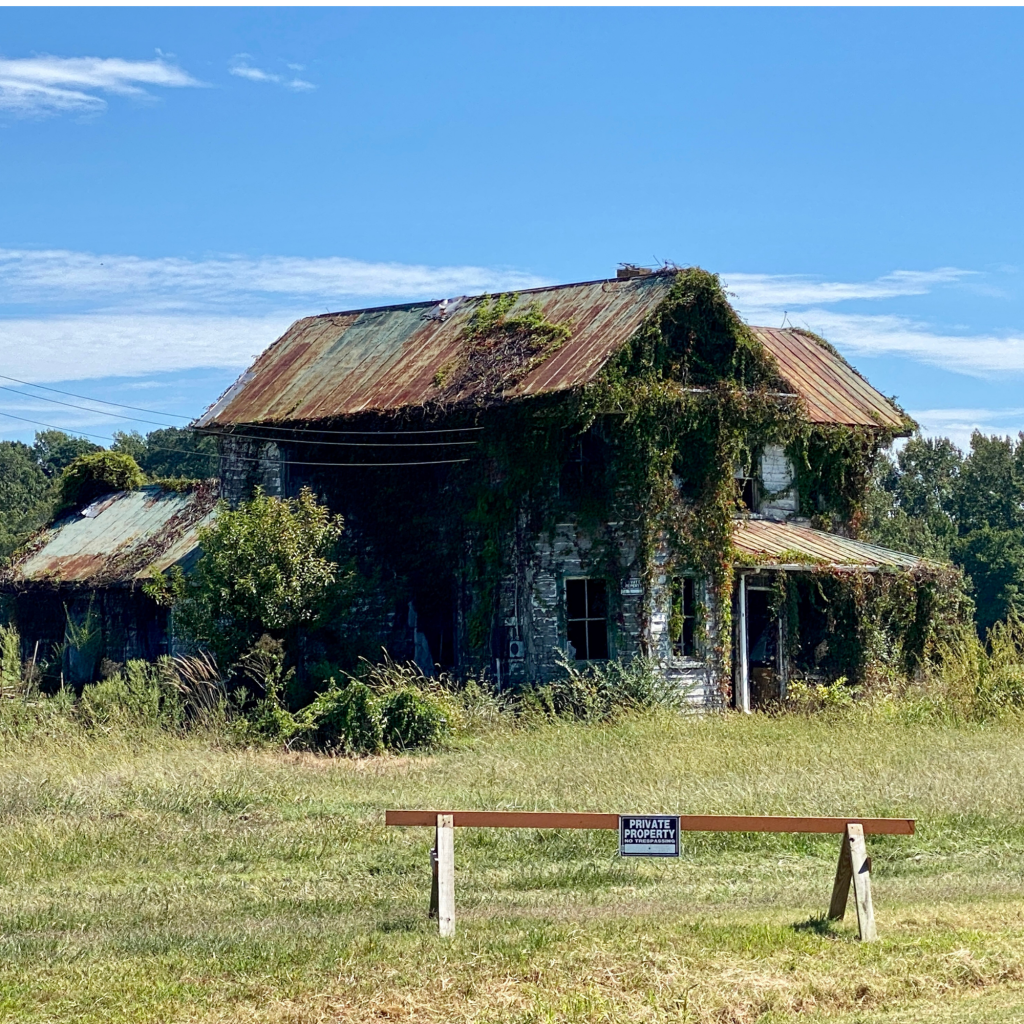
Take, for example, the image of the abandoned farmhouse. In a recent sermon on Revelation 12:1-6, I began this way:
Drive out of the city, into the winding countryside of Illinois, Iowa, or Wisconsin, and soon you will find them. They sit under ancient pillars of pine trees. Weeds wind over them like veins. In the summer, trumpet vines grab hold of them and prop them up. In the winter, they sit isolated, icicles becoming walls, snow heaping around them like sand dunes in the Sahara. And if a bad storm shakes them, next time you drive by they might just have collapsed.
Behold, a great sign appears in the countryside: the abandoned farmhouse.
As a child, we would ride out of Cedar Rapids, and soon, out the window of the car, on the old two-lane highways I would see these lost homes. Sometimes, the windows were boarded up like Floridians fortifying for a hurricane. At other ones, the broken windowpanes let everything in and doors stood ajar. Eventually, the old oaks would fall over, or the spruces would be split by lightning, and the old groaning walls would fall in, and you drive by and see it is not a house anymore but has collapsed under its own weight and the weight of history.
I then moved to discuss the emotion connected with this image:
I am sad every time I see one of these old, abandoned homes, often with barns leaning so far over (without falling!) they prove themselves more flexible than Olympic gymnasts. I am sad because every abandoned place once held people, like a cradle holds a baby. I look at the abandoned gardens, which once gave food and beauty. I see the driveway, where once was parked the cars of husbands or wives, mothers or fathers, sisters or brothers, people who loved and failed and lost one another, and who now are gone.
Take long enough to look at these abandoned places, and you begin to realize that each holds a story. Beneath the creaking floorboards, above the rotted roof, under the leaking limestone basement, there is a deeper story, a story of trial and loss, of hard work and hope, of struggle, decay, and time.
This imagery became the dominate image that weaved through and moved the message forward. The abandoned farmhouse stands in for the world, Satan the great corrupter and devourer, and Christ is born, then, not in the palaces of Jerusalem but on the creaking floorboards of a ramshackle house with raccoons in the attic. I end the message like this:
What happens next, for you, for me, for this abandoned farmhouse world, belongs now to Jesus, the One born of a woman, the One who by letting the farmhouse walls cave in on him promises to bring you, and me, and all who trust in him, and every broken building or body, every fallen barn, lost love, forgotten place, and sad time itself— he promises a day when he will say “behold, I am making all things new.”
Now, it is up to God, you, and time whether that is effective communication. But know this: a little boy recently from our church sat with his parents and watched the fireworks on fourth of July, and he turned to his parents and said the flaming sky reminded him of a sermon I had preached which began with these words:
The dove descending breaks the air
With flame of incandescent terror
Of which the tongues declare
The one discharge from sin and error.
The only hope, or else despair
	Lies in the choice of pyre or pyre—
	To be redeemed from fire by fire.

	Who devised this torment? Love.
Love is the unfamiliar Name
Behind the hands that wove
The intolerable shirt of flame
Which human power cannot remove.
	We only live, only suspire
	Consumed by either fire or fire.

T.S. Eliot, "Little Gidding" IV.
And in that moment, a crewman dropped from the sky ship and lightened up that little mind.
That’s enough for now!


 Revival and Renewal
Leave a comment