
I go to the Art Institute with a plan. Scribbled onto a spare page in my sketchbook are gallery room numbers, specific questions I want answered, and new things to discover. I never go to see Picasso (unless I’m under duress). I skip whatever doesn’t interest me. I know what I want to see, and I make sure I see it.
But a few months ago, while whisking through the 16th century Spanish painting galleries in search of a lesser-known Velazquez, I was stopped in my tracks. I was so struck I had to sit down. Before me, emerging out of the darkness, was a scene both gruesome and tranquil. The stillness of Monday morning left the room reverent and still, and in this stillness the painting before me seemed to draw me in. It was a large, life-size painting of Christ crucified by Francisco de Zurbarán. I sat down and had to record a small sketch of it.
In it, Christ hangs on the cross, the color drained from his face, his side pierced in the deep shadow. His figure and cross stand alone in contrast to a background of pure black. He is lit from the right side, the cool light accentuating the stretch-and-stress of each ligament as he hangs there. The longer you look the more you admire: the mastery of anatomy, the brilliant application of paint in thin glazes. His mastery of the craft of oil painting is amazing.
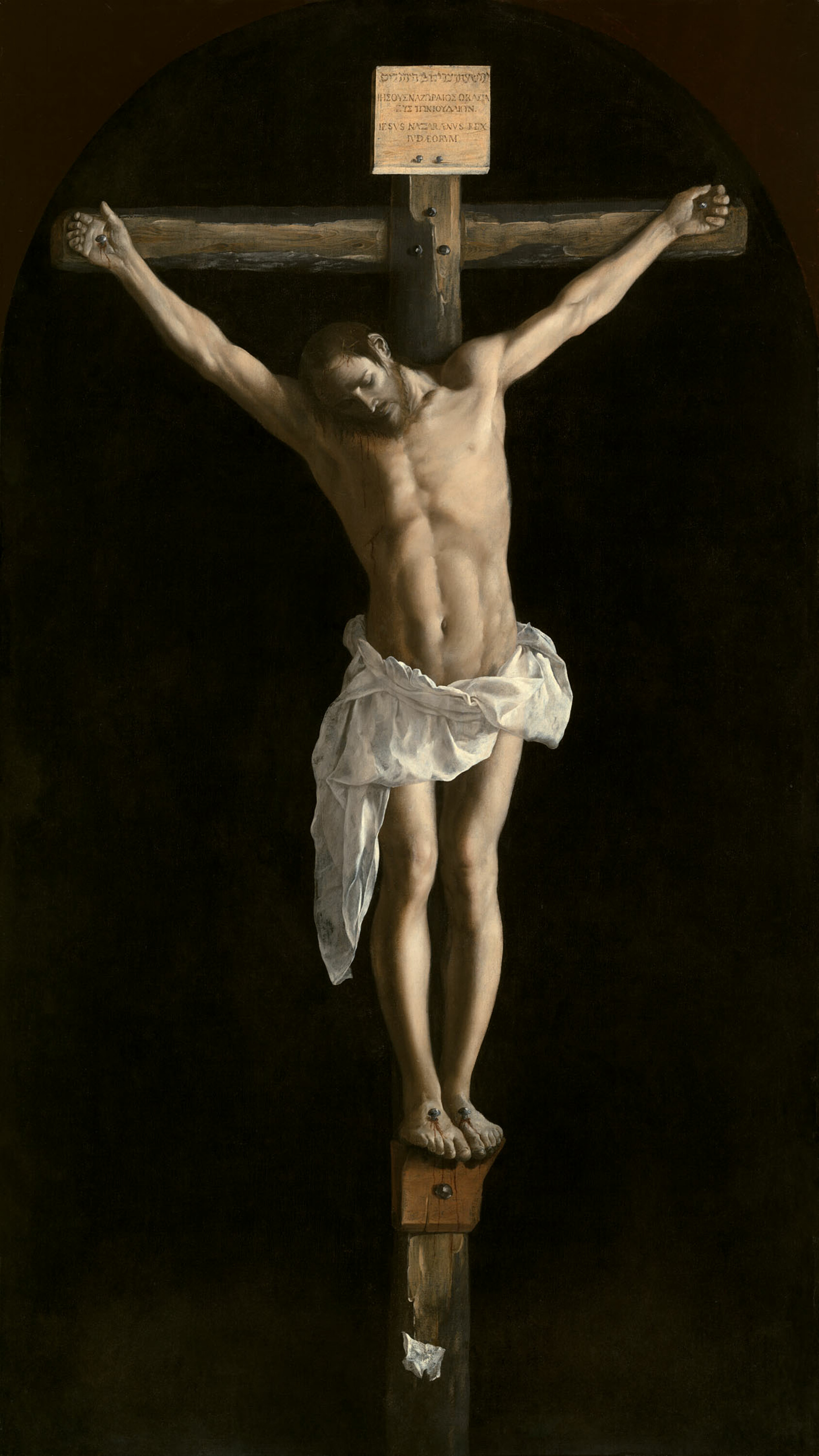
But Zurbarán’s Christ also disturbs you. There is something in that image that assaults and confronts. In it we find not just well-modeled flesh, but the trickling of blood. Christ’s not just alone in this world of blackness; he’s been abandoned. The more you look, the more details emerge: the knotted wooden cross and the glimmer on the nails piercing his feet; the white cloth tied around his waist; the lack of vivid color. And, painted with painful accuracy, you find a crumpled-up piece of paper falling from the scene in which the artist has inscribed his own name, as if painting this scene of torture has caused him great pain, too.
Paintings like this litter the Christian tradition, but they often confuse modern sensibilities. As we said last week, true art both affirms the old creation and envisions it as God’s presence. But, if this is true, how can we possibly justify this image of ugliness? Christians have always been accused of being a macabre bunch, obsessed with blood, suffering, and death. Doesn’t Zurbarán confirm such an obsession?
I think there is a deeper answer to these questions, an answer that we find hidden in the themes of the Tabernacle story of Exodus. Woven into that story is the insistence that the divine life, the life we desire, the life of beauty, doesn’t come easy. It costs us. What’s more, it costs God. If we are going to be invited into God’s presence-on-earth, the only path is one of sacrifice. And in that sacrifice, by that sacrifice, we find a kind of strange beauty.
Beauty in its fullness
Exactly as I show you concerning the pattern of the tabernacle, and of all its furniture, so you shall make it.
Exodus 25:9
The vision of beauty in the Bible is at once mysterious and nuanced. While the world conflates the word “beautiful” with “attractive” or “pretty,” we find in the Tabernacle story, almost by accident, a radically different perspective. Throughout the Old Testament the words translated “beauty” are often off-shoots of the idea of “glory.” In fact, the two concepts are almost synonymous. One might say that beauty is the display of God’s glory in created reality. When a thing, such as the golden splendor of the tabernacle, is beautiful, it has a kind of visual glory, a glory that displays for the eyes to see. Glory in visual reality is beauty.
Beauty, then, accords with God. What is beautiful fits with God’s character and inner nature. Beauty’s mystery, its intractable complexity, relates back to God’s own mystery and complexity that we find in the Trinity. Just as the Trinity exists in a mysterious harmony of diversity and unity, desire and fulfillment, mutuality and individuality, so too beauty exists along those planes in life. In fact, I’d say that all created design exists along those planes and is patterned after the life of the Trinity. God is not only the most beautiful: he, in himself, is the pattern of beauty’s tensions and fulfillment.
Beauty on earth
Splendor and majesty are before him;
Strength and beauty are in his sanctuary.
Psalm 98:6
There is more in our Tabernacle story to tell us of beauty. For while it is true that God alone is the fullness of beauty, its patterns and fulfillments, we find that, as far as the biblical authors are concerned, the desired vision of beauty is God’s presence on earth. Human beings crave beauty: they were created and patterned after God’s own being to desire and behold the beautiful. But beauty, as we’ve said, is related to created reality. It calls us to crave, but that craving is very much rooted in the physical. As something accords with God’s design, it is beautiful.
This begs the question: what is the ultimate end of God’s design of created reality? The answer, I submit, is hidden in the Tabernacle. For, as we’ve said, the Tabernacle hearkens us back to the first garden-temple, to the original intention of the world as God’s dwelling place with humankind. The world was intended to be God’s temple. For this reason, whenever the Biblical authors talk about the most beautiful place on earth, they refer to God’s dwelling place:
One thing have I asked of the Lord, that I will seek after: that I may dwell in the house of the Lord all the days of my life, to gaze upon the beauty of the Lord and to inquire in his temple.
Psalm 27:4
Out of Zion, the perfection of beauty, God shines forth.
Psalm 50:2
Whatever our desires for beauty, we find them ultimately leading us somewhere, and I think that somewhere is Eden. We desire the fulfillment of all beauty in the garden-temple-city. Behind all desire for beauty is a desire to be with God, to know God, to see God, but not just as a disembodied soul in a realm of clouds. No, the desire for beauty is a longing to behold God on earth, to enter the Holy of Holies and dwell with him.
The Strange Beauty of the Cross
Now this is what you shall offer on the altar: two lambs a year-old day by day regularly…It shall be a regular burnt offering throughout your generations at the entrance of the tent of meeting before the Lord, where I will meet with you, to speak to you there. There I will meet with the people of Israel, and it shall be sanctified by my glory
Exodus 29:38, 42-43.
We see here how the idea of beauty and sacrifice become intertwined in the Bible. The ultimate vision of beauty in the Bible is God’s presence on earth. But there is no way for us to enter the presence of God on earth without sacrifice. It is costly to draw near to God. Looking at the Tabernacle, it becomes clear that we must be cleansed of our sin. Beauty, true beauty, cannot be attained without sacrifice.
But just any sacrifice is not enough. We see in Exodus that even with the continual shedding of blood, even with all the cost, very few actually get to enter the Eden-place that is the Holy of Holies. God’s holiness and his beauty are intertwined. And so, most just watch in the ugliness of the wilderness as the radiant priesthood enters in. In this wilderness, on this side of the curtain, we may catch flickers of true beauty, but they are fleeting, like the fading flower on the hillside (Isaiah 28:4). We desire a beauty that we cannot have; and we desperately want it.
This is the strange beauty of the cross, a hiding glory. In the cross, we find God himself taking on the ugliness of this fallen world so that we might enter into his beauty. In the cross we find a true sacrifice, a true atonement, a complete offering. There is in this bloody scene a hidden promise, that to those who believe, the longing of their hearts will not go unfulfilled, but they will enter that Eden-place. They will behold the real beauty of God in his sanctuary. Created reality will be filled with God’s glory, and the filling itself will make the world radiate with beauty.
The Hope of Beauty
The Bible story compels us to consider a deeper beauty. While the world around us is consumed with itself, its own prerogatives and desires, it will never find the Eden-place it is really looking for. When our phones tempt us to create it ourselves, to manufacture a fake vision of Eden-life for others to envy, the cross demands we look elsewhere. It demands we reflect, not just on what is beautiful here, but on the ugliness of sin. It compels us to remember how beauty is ultimately about God with us, and that this is achieved only by the death of his Son. It moves our eyes from the beauty that is fleeting to the beauty that brings hope. “For in this hope we were saved. Now hope that is seen is not hope. For who hopes for what he sees? But if we hope for what we do not see, we wait for it with patience.” (Romans 8:24-25).
Next week: the Creator and creatives: A vision of creativity
In the meantime
I couldn’t fit all my somewhat disjointed thoughts on beauty in this post, so I’ve compiled them here: Some Very Short (and By No Means Clear) Thoughts on Beauty

 Revival and Renewal
Leave a comment