
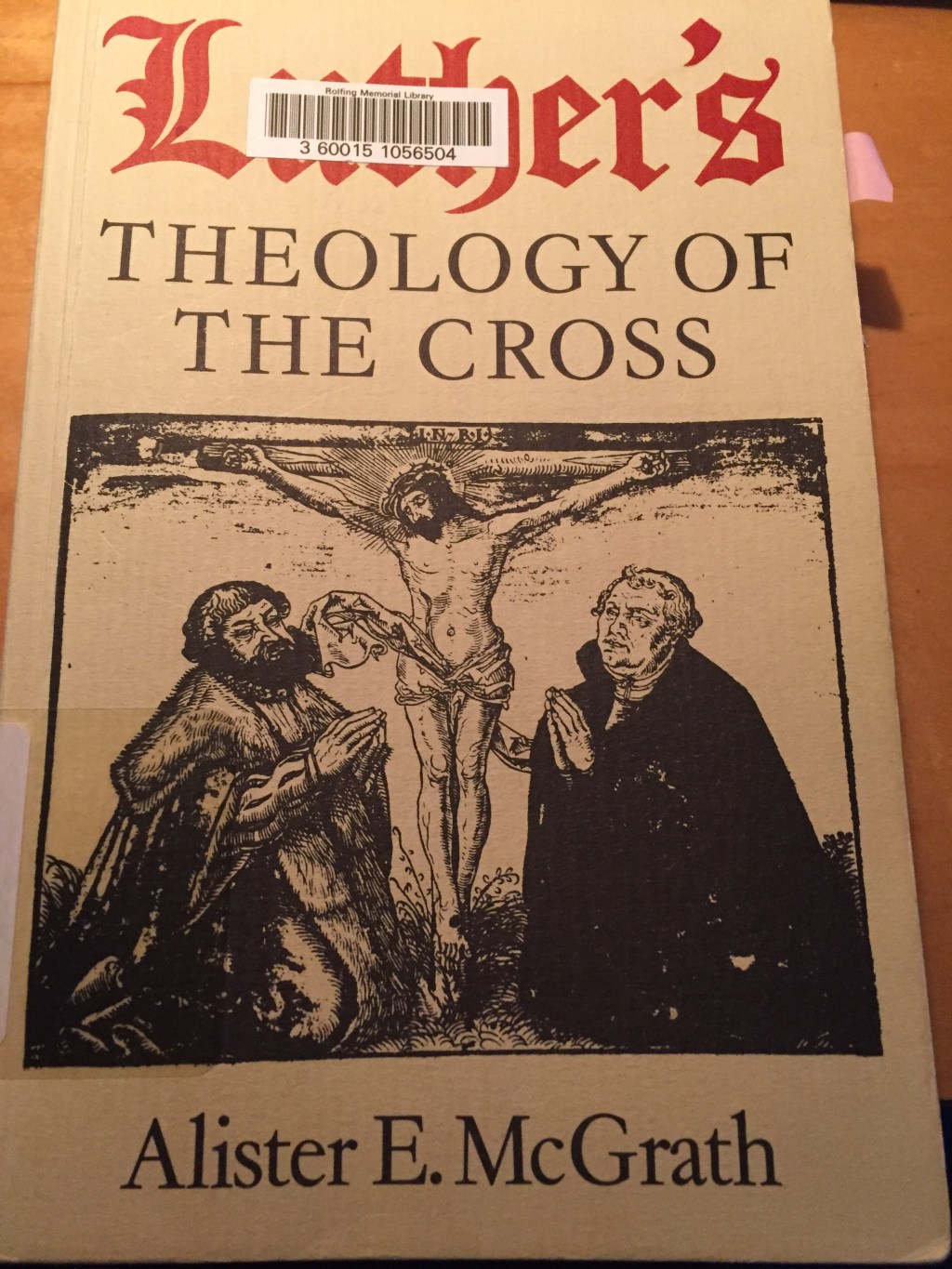
[This is the third and final part of a summary of McGrath’s excellent book Luther’s Theology of the Cross.]
[For the first part in the series, click here.]
[For the second part in the series, click here.]
Over the last semester, I have been digging into the question: how is it that we do theology? What makes it possible? In the ensuing research, I landed on Luther’s theology of the cross, an oft-talked about but seldom-understood theological viewpoint that was a fruit of Luther’s reformation. The contrast is often conceived this way: Calvinists are “theologians of glory”, putting emphasis on God’s “glory” at the expense of Christ. But Luther and his followers put emphasis on Christ, because they view him as the center of theology.
While this exposition of Luther’s theology of the cross is convenient, it is far from accurate. The theology of the cross, as has been pointed out here, is in contrast to a theology which places emphasis on man’s reason and ability to find God independently of revelation. A theology of “glory” glorifies man, not God. Luther’s criticism of the theologians of his day had to do with just this, an over-emphasis on Aristotelian logic to the expense of the clear teaching of Scripture and a Christ centrality. The clearest example of this is in the Heidelberg Disputation (one of Luther’s summaries of the theologia crucis), theses 19 and 20:
19. The man who looks upon the invisible things of God as they are perceived in created things does not deserve to be called a theologian.
20. The man who perceives the visible rearward parts of God as seen in suffering and the cross does, however, deserve to be called a theologian. (quoted in McGrath, p. 148).
Yet as Alister McGrath points out, Heidelberg (c. 1518) is not the extent of evidence which Luther provided for the theologia crucis. This is a position which he came to due to his radical re-understanding of the righteousness of God (which parts 1 and 2 detail), which began as early as 1515. We now will look at some of the nuances of this theological position as described in McGrath’s Luther’s Theology of the Cross.
McGrath summarizes the theology of the cross with five points. The first is that the theology of the Cross is a theology of revelation (p.149). This is put in contrast to speculation, the process of using reason to come to conclusions about God without the aid of his revelation. A theology of the cross bases itself on God’s self-disclosure, and assents to work within that framework “instead of constructing preconceived notions of God which ultimately must be destroyed.” (p.149). This is birthed, again, out of Luther’s new understanding of iustitia Dei, one in which he contrasts man’s comprehension of righteousness with God’s revelation of his righteousness. God must break down our preconceived notions of what it looks like to be right before him (which we by-default suppose to be by works), and reveal to us that righteousness really comes only through faith in Christ (which he reveals ultimately through suffering and the cross).
Secondly, the theology of the cross regards revelation as indirect and concealed (p.149). In thesis 20, Luther claims that the theologian bases their work on the “rearward parts of God” (posterior Dei). This, McGrath notes, is an allusion to Exodus 33:23, in which God reveals his “back parts” to Moses rather than his face. The dissonance which one feels when they look to the cross and see God’s Son suffering and dying a gruesome death is due to the fact that we expect to see God’s face (in splendor and glory), but when we look with our reason all we see is his “rearward parts.” McGrath explains this well: “In that it is God who is made known in the passion and cross of Christ, it is revelation; in that this revelation can only be discerned by the eye of faith, it is concealed.” (p.149).
This ties into McGrath’s first point. God has chosen to reveal himself in a hidden and indirect fashion, through the cross, rather than through reasoning without the cross. Because in a sense “God is on the cross”, one must look to the cross when they look for God. “Any attempt to seek God elsewhere than in the cross of Christ is to be rejected out of hand as idle speculation.” (p.161).
The third point which summarizes the theologia crucis is this: God’s revelation is seen in “the sufferings and the cross of Christ, rather than in human moral activity or the created order.” (p.150). While Luther admitted that man can have some notions of God which derived from nature or reflection on man’s moral sense, these at best produce a transcendent, as apposed to personal, conception of God” (p.162). McGrath separates the two understandings of God as “cognitive” vs. “existential”; while reason may produce some accurate notions about God, only the cross viewed through the eyes of faith produces real knowledge of who God is. (pp.162-163).
In an interesting section (pp.163-164), McGrath elaborates on this point. To Luther, people indeed have preconceptions of God (the mind is not a tabula rasa), vessels through which they appropriate divine revelation. But these preconceptions are destroyed by the vision of the “crucified God.” To our minds, seeing God on the cross is impossible if we merely view God as a “first cause” (cf. 1 Cor. 1:18-31). To view God on the cross is to put our natural abilities on trial, to bring us to a point where we either have to admit that God isn’t the way we thought he was or that it isn’t God on the cross at all.
The cross is thus a catalyst to true knowledge of God. This brings us to McGrath’s fourth point: to know the crucified God one must look in faith (p.150). The posteriora Dei is only recognized as a revelation from God through the eyes of faith, while the theologian of glory misses it because they look to their senses for all the answers. As McGrath notes, Luther uses John 14:8 to illustrate his point. Jesus is confronted by Philip with the burning request to “show us the Father, and it is enough for us.” Jesus’ reply is pointed: “Have I been with you so long, and you still do not know me, Philip? Whoever has seen me has seen the Father.” Philip in this scene is a “theologian of glory.” He just wants to be able to comprehend the Father (in all his greatness and holiness, cf. Isa. 6:1-4), while he misses that that same God sits across from him. The eyes of faith perceive that God is in Christ, while the eyes of reason can’t grasp what is going on.
The fifth and final point which separates the theologia crucis is that God is known through suffering (p.150). God makes himself known through the sufferings which men experience, and the eyes of faith see this as the gracious work of God. McGrath quotes Luther: “an action which is alien to God’s nature results in an action which belongs to his very nature” (p.151). The disconnect is between what is known as the proper work of God and the strange work of God. God uses spiritual assault (illustrated by the German Anfechtung) to humble man, bringing him to a point of despair and the complete breakdown of his self-confidence, in order to save him. For as long as man believes he can find God on his own, he is lost. But once he acknowledges that he is unable to save himself he is thus able to trust in Christ by faith, looking to the Anfechtung of Christ to save him. “It is through undergoing the torment of the cross, death and hell that true theology and the knowledge of God come about.” (McGrath, p.152). This is the explanation of Luther’s famous saying: “THE CROSS alone is our theology” (quoted on p.152, the capitals are Luther’s).
A few clarifications are in order:
- Luther identifies God’s usage of suffering as part of his hidden and indirect revelation to mankind. This is not, as Luther would say, the “opus proprium” (proper work) of God. He hides behind suffering and the cross and through suffering brings men to himself.
- Luther followed Isaiah in his proclamation: “truly you are a God who hides himself!” (Isa. 45:15). McGrath clarifies that this hiddenness implies that God hides himself in order to reveal himself. He quotes Luther: “Man hides his own things, in order to conceal them; God hides his own things, in order to reveal them.” (p.167). God’s work is thus paradoxical, and “there is a radical discontinuity between the empirically perceived situation and the situation as discerned by faith.” (McGrath, p.167). Luther finds that all that man can perceive of God via reason are his “back-parts”, and expects God to “be revealed in strength, glory and majesty.” (p. 167). God on the cross comes in weakness and folly, and therefore the theologian of glory can’t comprehend it.
- McGrath notes that the theology of the cross puts emphasis on “faith.” It is important to emphasize that Luther is not saying that faith flies in the face of evidence. In fact, Luther is saying that man is unable to properly understand the evidence that is in front of him. Philip was looking at God, but could not perceive that indeed it was God who talked to him. Man’s basic way of going to God, then, is unable to get past the visible, while God still lies hidden. Faith “is characterized by its ability to see past visibilia [the visible things] and recognize the invisbilia [the invisibles] that lie behind them.” (p.168). McGrath describes Luther’s doctrine of faith as (1) hearing the word of promise in the Word of God (especially preached) and (2) a bond which unites the believer with Christ (p.174).
- Based on the fact that only the eyes of faith can perceive God’s activity in the world, McGrath goes on at length to discuss the conflict which the believer will experience between faith and experience. In the realm of experience it will look as though God is against us, but by faith behind it we see a smiling God. The main tension, however, comes from Anfechtung, a word McGrath defines as “assault.” It is both (1) the objective assault of spiritual attack upon the Christian and (2) the “subjective anxiety and doubt which airs within him as a consequence of these assaults”(p.170). While experience will say this is the ultimate reality, faith sees it as a means to “reduce [us] to a state of utter despair and humiliation, in order that [we] may finally turn to God, devoid of all the obstacles to justification which formerly existed.” (p.170). Anfechtung is God’s hidden and strange work, used by God so that man might come to him in faith alone.
- The theology of the cross revolves around Christ. All the tensions which Luther creates around God’s hiddenness and strangeness find their resolution in the cross of Christ. Christ experienced Anfechtung, the searing pain of spiritual suffering, for us, imparting to us a righteousness from outside. McGrath points out the mystery of the cross, that man is given God’s righteousness while Christ is given man’s sin (p.173). When one looks to Christ on the cross in faith, they view God, and have true and living knowledge of God as he has revealed himself. And through this they can begin truly to be theologians.

 Revival and Renewal
Leave a comment