
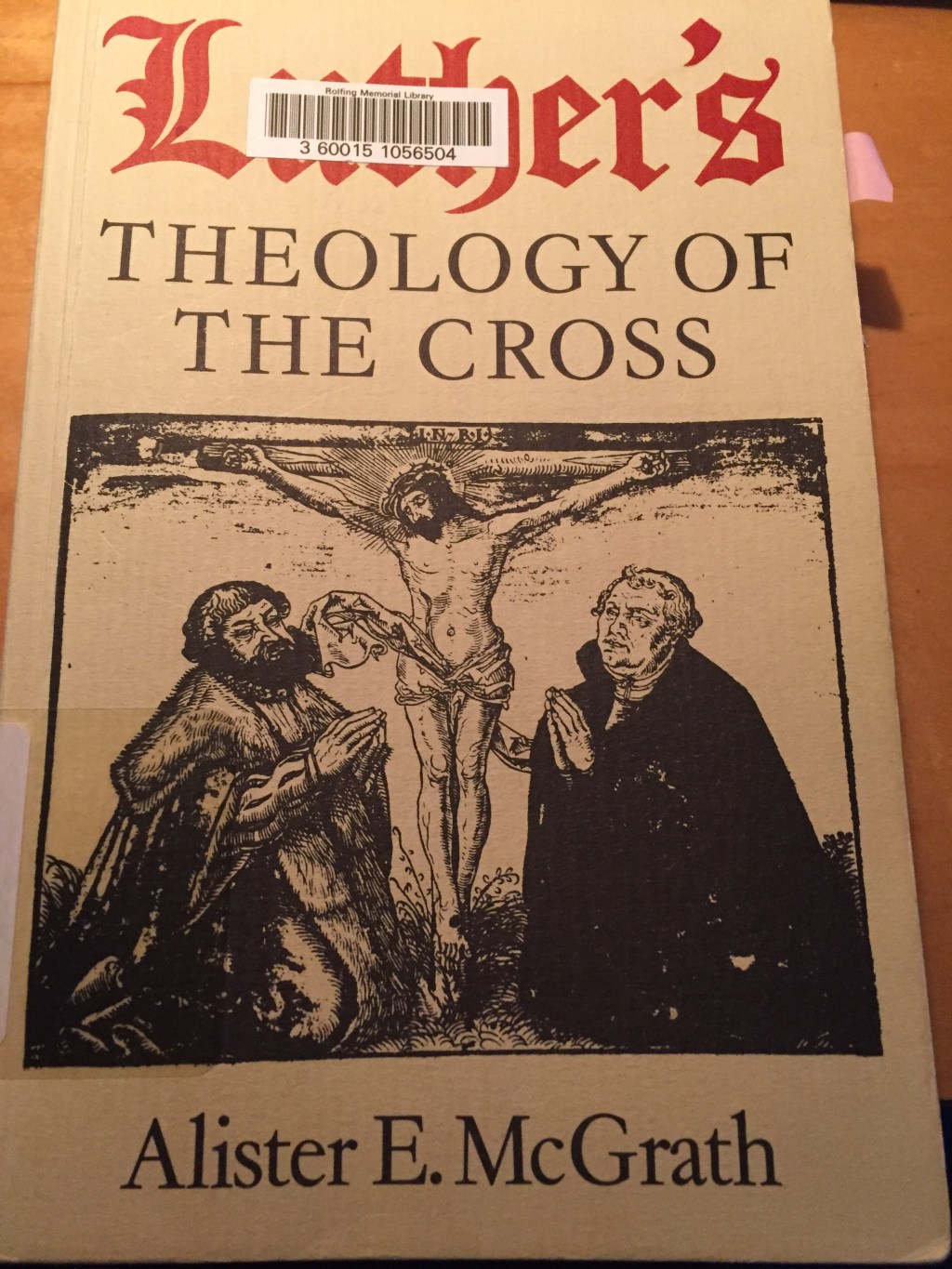
[This is part Two of a series on Alister McGrath’s great book, Luther’s Theology of the Cross]
In the last post I attempted to summarize McGrath’s research regarding the theological background in which Luther operated. McGrath argues strongly that Luther, between 1509-1514, was operating as “a later Medieval theologian,” (chapter 3), and that his thoughts regarding “the righteousness of God” were based out of that tradition. He highlights Luther’s usage of the Quadriga hermeneutic, with it’s fourfold interpretive structure, and also his basic understanding of iustitia Dei as according to that of the via moderna school of thinking to which he owed his education.
The definition of iustitia Dei is itself what sparked Luther’s inner quandary. McGrath reveals that the definition which Medieval theologians preferred to describe God’s righteousness came from Roman law, specifically from Cicero, summarized as reddens unicuique quod suum est (giving each one what he deserves). This definition, however, leaves out the important fact that God justifies the ungodly. How can God be just, while at the same time giving to a sinner what he doesn’t dererve?
This point, McGrath notes (p.102), was first made some thousand years before Luther by Augustine. Augustine points to the parable of the Laborers of the Vineyard as an example of how God’s justice differs from man’s. In that story, Jesus states clearly that the laborers who began at the end of the day received the same wage as those who began at the beginning. In this sense, they didn’t get what they deserved, but rather much more. This, despite a lack of Augustine’s knowledge, links up with the sense of the Hebrew sdqh (“righteousness”) which carries the meaning of “to be continually faithful, beneficial” (cf. Amos 5:24). McGrath next points to a poem, entitled The Pearl, written c. 1370, in which a father remarks that God is not just to bring his dead infant daughter into paradise if his righteousness is defined as reddens unicuique quod suum est. These critiques of the definition of God’s righteousness which prevailed in Augustinian Medieval theological circles were themselves prototypes of Luther’s own theological dilemma.
Luther’s main dilemma also revolved, in a broader sense, around the soteriology of the via moderna. McGrath summarizes the via moderna’s viewpoint well:
God, in his mercy and liberality, ordained to enter a pactum with man, by which he is prepared to ascribe a much greater value to human acts than they are inherently worth. Thus although a man who does quod in se est has done nothing of any particular inherent value, God accords it a much greater value within the terms of the pactum, allowing it to function as the contracted link between man’s natural state and the state of grace…God, having freely determined to enter into such a pactum with man according to which he will reward whoever does quod in se est with grace, is now obliged to respect the terms of this covenant. (pp.104-105).
This soteriological viewpoint was informed itself by the afore-mentioned Ciceronian definition of righteousness. In a sense, it was an attempt to answer the question of how a person could ever themselves be righteous before God.
Luther ascribed to this theological perspective as late as 1514 (p.108). He reproduced almost an identical definition of righteousness in his commentary on Psalm 10:9, calling it “rendering to each man his due.” (p.108). Yet by his Galatians lectures of of 1516-1517, he says this while commenting on Galatians 2:16:
A wonderful new definition of righteousness! This is usually described thus: ‘Righteousness is a virtue which renders to each man according to his due.’ But here it says: ‘Righteousness is faith in Jesus Christ (fides Jhesu Christi)! (p.112).
Luther had come to a radically different definition of iustitia Dei. Now, instead of it being God giving everyone what he deserves, we see that it is a gift given to the human race by God that they might be justified through faith in Christ.
There are several aspects of this new definition which deserve our attention. First, this definition highlights the standard by which God will judge the world, contrasting human righteousness with God’s righteousness. Luther certainly held that God will judge the world, but made the central point that such a judgment would occur through Christ. (p.115-116). Luther saw, as has been previously noted, a fundamental disconnect between God’s righteousness and man’s, and thus there was a completely different requirement in order to be justified coram De0 (in the sight of God) as opposed to coram hominibus (in the sight of man). Because God will judge the world through Christ, the one who is “righteous” is the one who has faith, though by man’s standard he is a sinner. This is the real logic behind Luther’s famous phrase, iustus et peccator simul – simultaneously righteous and a sinner. (cf. p.134). One is righteous in God’s eyes, but before men, they are still a sinner.
Secondly, Luther began to realize that the gift of faith was God’s work in humans. McGrath points out three conclusions that Luther came to in around 1515-1517:
- Man is now understood to be passive towards justification.
- Luther states that man’s will is held captive by sin, and is incapable of attaining righteousness unaided by grace.
- The idea that man can do ‘quod in se est” is denounced as Pelagian. (p.130).
Luther thus came to the conclusion in line with Augustine, that the will is better described as “enslaved” than “free.” (p.130). Faith becomes therefore a gift, something which God bestows on humans. This is a marked break from the soteriology of the via moderna, because now God’s relationship to man’s abilities is radically re-understood. While before God had made a covenant to accept works which were inherently worth little, now God forgoes that entire process and gives the grace of faith to the sinner.[Note: McGrath points out how the later Luther, in his defense of these positions, goes far beyond the Augustinian view on man’s inability in his servum arbitrium (“the Bondage of the Will”), p.133).]
Thirdly, McGrath touches on the now-famous phrase of Luther’s: iustitia Christi aliena, the alien righteousness of Christ. Luther has come to the conclusion that the entire person is mingled with both “flesh” and “spirit”, so much so that one cannot distinguish them as simply different, exclusive parts of the human composition but rather coexisting together. Justification has reference, not just to the spiritual aspects of a person, but to their fallenness as well (p.134).
Because justification involves the totus homo (the whole man), it cannot be said to already exist within him. It has to come from the outside, it must be an alien righteousness. It is something which is bestowed on man from outside him (extrinsic), rather than something which is already within him (intrinsic). “This concept of justifying righteousness is, of course, totally different from that of St. Augustine,” McGrath notes (p.134), going on to remark that Melanchthon would develop into the doctrine of “forensic justification.” Again, this adds another layer to understanding to the phrase iustus et peccator simul. Man is righteous extrinsically, via the alien righteousness of Christ, but intrinsically he is still a sinner. If the entire person is to be justified, it must be given a righteousness on from outside them, because on our own our wills are “prone only to evil.” (Luther, quoted on p.129).
The major change in Luther’s understanding of iustitia Dei revolved around the question, how can God’s righteousness be gospel? The answer was because it is by faith in Christ that men are justified. This dynamic conclusion was both revolutionary in it’s simplicity and its sources: Luther was willing to base his views on the Word of God, spurning much theological conversation of his day as irrelevant. In his defense of his views before the Deit of Worms he made this unmistakably clear:
“Since your majesty and your lordships desire a simple reply, I will answer without horns or teeth. Unless I am convinced by Scripture and by plain reason (I do not believe in the authority of either popes or councils by themselves, for it is plain that they have often erred and contradicted each other) in those Scriptures that I have presented, for my conscience is captive to the Word of God, I cannot and I will not recant anything, for to go against conscience is neither right nor safe.” [Note: some sources add the famous last phrase: “Here I stand; I can do no other. God help me. Amen”, but its not clear whether Luther actually said this.]
Now that we have established Luther’s discovery of the righteousness of God, we will move on in the next and final post to consider his theologia crucis in light of this development.


 Revival and Renewal
Leave a comment