
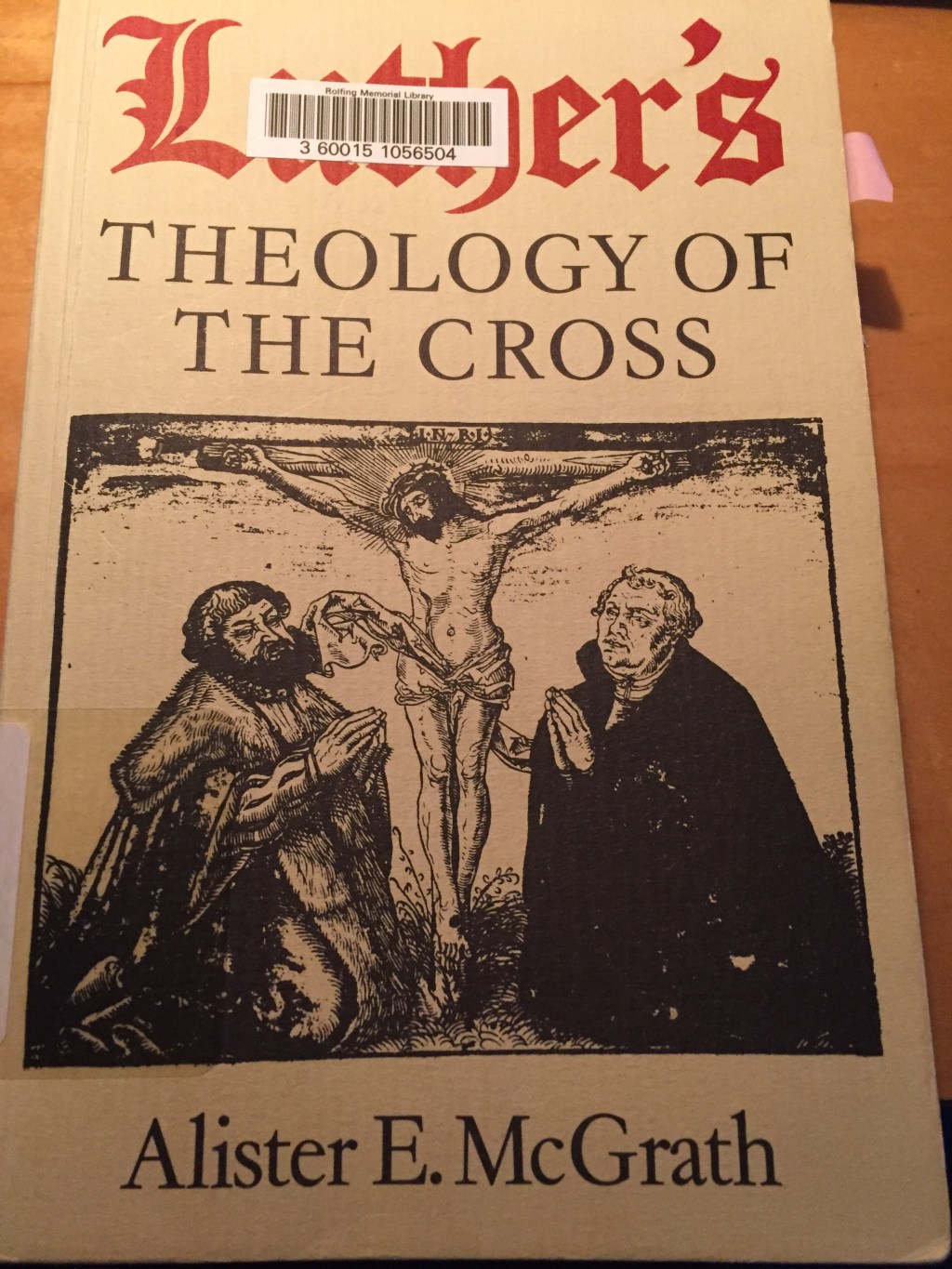
So I just finished reading Alister McGrath’s wonderful work Luther’s Theology of the Cross. I had wanted to read this book ever since I became a fan of McGrath’s work, having read through both his Christian Theology and Historical Theology, respectively. Yet, when in the midst of temptation I went to Amazon.com and looked it up, it was revealed that it was a whopping $79! So I waited until I came to Trinity to pick it up in the Library, and than read through it.
This is, in a way, “part two” of a series of posts I am doing on my research regarding “the theology of the cross,” that theological perspective which sees the cross of Christ as the foundation of theological reflection. McGrath’s work, I must say, is a masterful treatment of the historical development of the idea, focusing on how Luther’s understanding of iustitia Dei (“the righteousness of God”) developed and in a sense gave birth to the theologia crucis. He notes in the introduction that in the period of 1509-1519 Luther’s understanding of Justification underwent sustained and integral transformation, and that these insights are themselves “encapsulated in the concept of the ‘theology of the cross.’” (p.2).
I won’t try to summarize all of McGrath’s work here; there’s far too valuable a mine of reflection to be handled sloppily, and I advise you to read it yourself. The value of a study like McGrath’s is it give historical and theological grit to the formulation of Luther’s theologia crucis, rooting it in Luther’s development of his landmark understanding of Justification. While Luther’s famous ninety-five theses were posted on the church door in Wittenberg in 1517, McGrath points out that it was in around 1515 that Luther’s mind (and thus his works) began to really grapple with the proper meaning of iustitia Dei. The well-known struggle of Luther’s, revolving around Romans 1:17 “for in [the gospel] the righteousness of God is revealed..”, was how on earth the “righteousness of God” could ever be “gospel.” How could a righteous God ever be good news to sinners?
This struggle is exposited by McGrath masterfully, setting Luther in the tradition of late Medieval theology. He reflects on the fact that the second Council of Orange, with it’s distinctively Augustinian definition of Justification, is never cited by theologians of the Middle Ages, and from the tenth century to the council of Trent in 1545, “the theologians of the western church appear to be unaware of the existence of such a council, let alone of its pronouncements.” (p.11). Because of this, Medieval theologians based their theology of justification on more vague pronouncements (such as the council of Carthage), and along with other influences this produced a remarkable confusion regarding the doctrine of justification in the later Medieval period. (p.12).
Luther enters into the world of the academy as a theologian in the late Medieval tradition. McGrath details how he was influenced by northern European Humanism (which was a call back to the Scriptures and the writings of the fathers) with Erasmus of Rotterdam leading the way, which filtered into an Augustinian revival in Wittenberg by 1518 (pp.45-49). Secondly, McGrath points to the theological school known as the via moderna as the epistemological background of Luther’s thought. This method sought to understand justification as mitigated between what McGrath calls “the two powers of God” (pp.55-56).
The two powers of God are defined as the “absolute power of God” (potentia absoluta) and the “ordained power of God” (potentia ordinata). God’s absolute power describes his ability to do all things (“the initial set of possibilities open to God”. p.56). His ordained power, in contrast, refers to those things which God has ordained he will do. So, God could, in his absolute power, “remit sin without the infusion of grace.” (p.58). The main reason he doesn’t, then, is not because of any inherent value in infusing grace in the soul, but rather because he has made a covenant (pactum) that it should be so. To those who espoused the via moderna, the pactum which God had made with man was this: facienti quod in se est, Deus non delegate gratium, “God does not deny grace to the man who does his best.” This line McGrath calls a “celebrated medieval axiom” (p.60), and it sums up the confused world into which Luther encountered that haunting question: how can a righteous God be gospel? If the gospel is summed up in God rewarding man via the covenant with grace because he met some precondition, how would you ever know when you had done “your best”? And what part, if any, does Jesus play in this kind of thinking?
Luther’s eventual answers to these questions are the main substance of the book, as we will see in the next part of the series.


 Revival and Renewal
Leave a comment